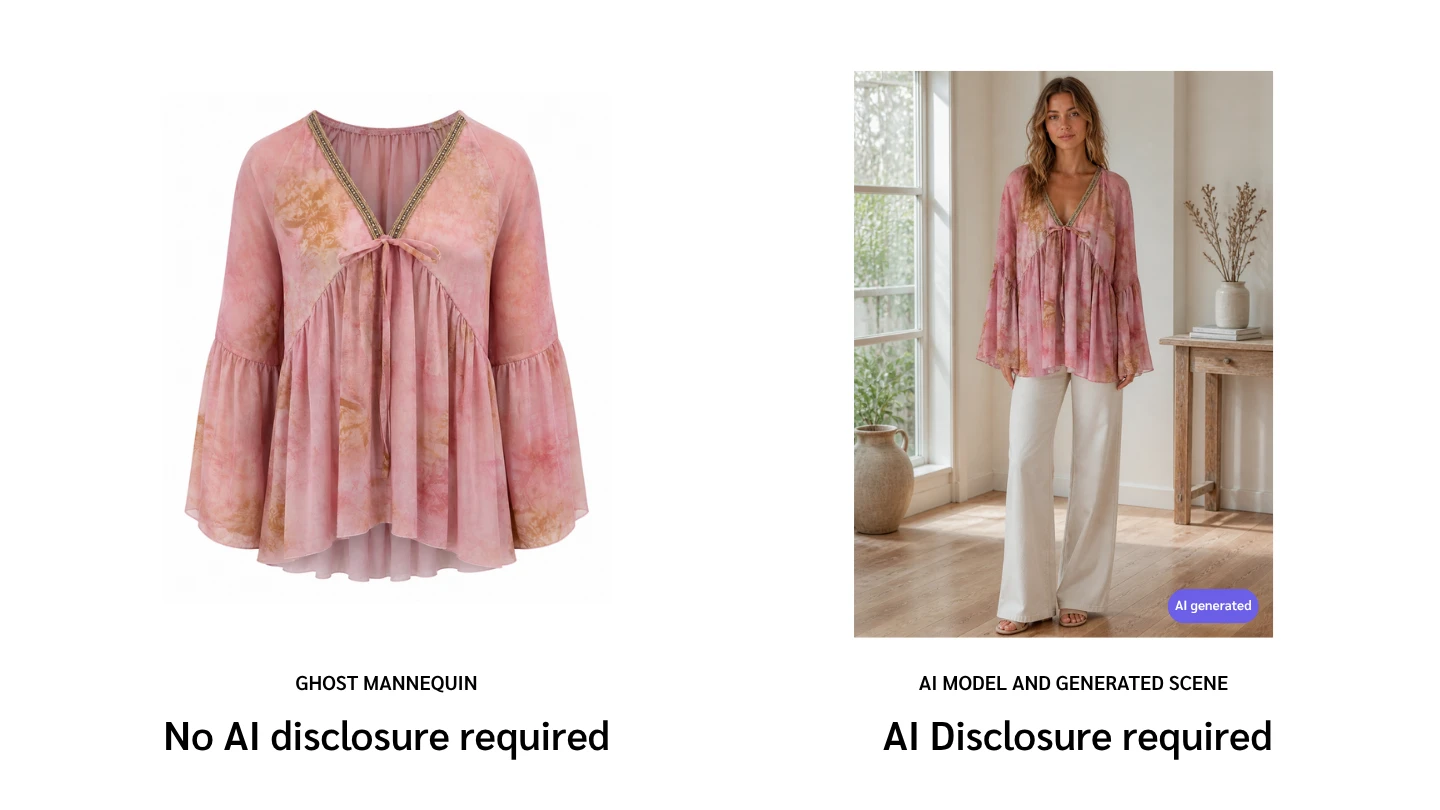
What the EU AI Act Actually Requires for AI Product Photos
By Snaproom · July 19, 2026 · 9 min read
Published 19 July 2026. Reviewed quarterly.
From 2 August 2026, the EU AI Act requires AI tool providers to mark generated images in a machine-readable format. Sellers face a separate obligation: visible disclosure, but only for content that qualifies as a deep fake. Ghost mannequin and background removal are unlikely to qualify. AI-generated models almost certainly do.
That is a meaningfully different answer from the one most guides are giving right now, so the rest of this article shows you where it comes from in the text of the law.
This is not legal advice. The rules are new, the Commission's guidelines are still in draft, and several points below are genuinely unsettled. If you sell at scale into the EU, get an opinion from a lawyer.
Article 50 of the EU AI Act sets out transparency obligations for AI systems. Those obligations become enforceable on 2 August 2026, along with the penalty machinery behind them.
Article 50 is not one rule. It is four separate rules that apply to different parties. Two of them matter for product photography, and they are frequently confused with each other.
If you read three articles about this, you will probably come away thinking that every seller must put a visible "AI generated" label on every product image shown to EU customers. That is not what the text says.
Article 50 splits the obligation between two roles:
These two roles carry different duties.
Article 50(2) applies to providers. It requires that providers of AI systems generating synthetic image content ensure their outputs are marked in a machine-readable format and detectable as artificially generated or manipulated.
Two things follow from this.
First, this is a technical obligation, not a visual one. Machine-readable marking means metadata embedded in the file, using standards such as C2PA Content Credentials. It is not a watermark or a caption. A customer looking at the image would not see anything.
Second, it is not your obligation. It sits with the tool you use. Your practical exposure here is indirect: if your tool does not mark its outputs, or if your workflow strips the metadata during compression or upload, you lose the provenance record that demonstrates how the image was made.
Article 50(4) is the deployer obligation, and it is narrower than most coverage suggests.
It requires deployers of an AI system that generates or manipulates image, audio, or video content constituting a deep fake to disclose that the content has been artificially generated or manipulated.
The obligation attaches to deep fakes. Not to all AI-generated images.
A second paragraph of Article 50(4) covers AI-generated text published to inform the public on matters of public interest. That is aimed at news and journalism, not product descriptions.
So the question that actually determines your obligation is a definitional one: does your product image count as a deep fake?
Article 3(60) defines a deep fake as AI-generated or manipulated image, audio, or video content that resembles existing persons, objects, places, entities, or events, and would falsely appear to a person to be authentic or truthful.
Two things about that wording matter. It covers objects and places, not only people, which is broader than the everyday use of the word. And Recital 134 adds the qualifier "appreciably" before "resembles", which sets some threshold of similarity without saying where it sits.
The clearest way to see where the line falls is to take one garment through three treatments and change only one thing at a time.
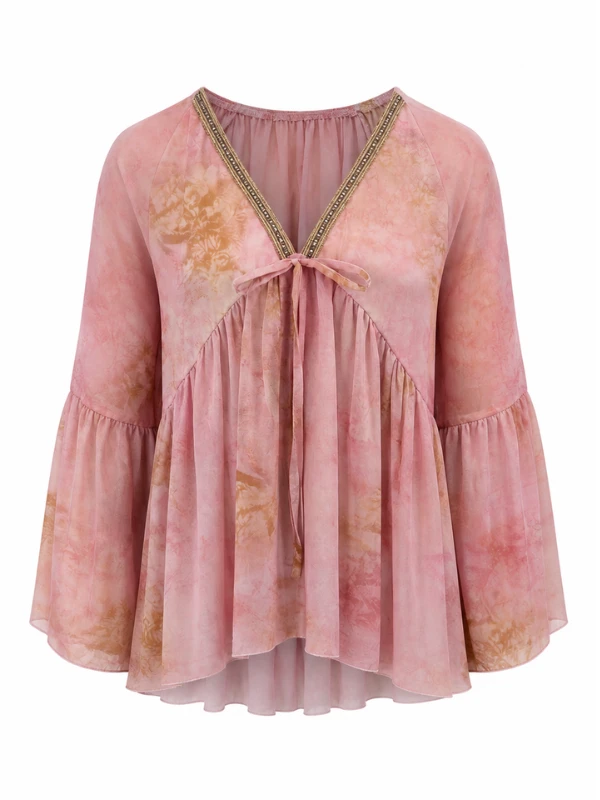
Case 1: ghost mannequin or background removal.
Nothing here has been invented. The blouse is real, the shape is the shape of the actual garment, and the AI has removed a mannequin rather than creating anything. There is no place, person, or event being depicted that did not happen. It is hard to argue this falsely appears authentic, because it is authentic. This is unlikely to be a deep fake. If the format is new to you, our complete guide to ghost mannequin photography covers how it is produced and what it is used for.
Case 2: the same garment in a generated room.
The blouse is unchanged. The room is not real. The window, the floor, the light falling across the wall, none of it exists. A viewer would reasonably assume this photograph was taken somewhere. That is a place resembling a place, presented as authentic, which sits inside the definition. A cautious reading discloses.
Case 3: the same garment on an AI-generated model.
Same blouse, same room, one addition. This is the case sellers ask about most, and there is now an answer.
The intuitive argument for exclusion is that the model does not exist, so she cannot resemble an existing person.
The Commission's draft guidelines on Article 50, published in May 2026, close that argument off. Legal analyses of the draft report that it is sufficient for the simulated subject to resemble someone or something that could exist or could once have existed in reality. On that reading, a realistic synthetic depiction of a fictitious but natural-looking person is a deep fake.
The same analyses note that the assessment is intent-independent and audience-oriented. It does not matter that you were not trying to deceive anyone. What matters is whether a viewer would take the image to be authentic.
The practical conclusion is straightforward. If you publish AI-generated on-model imagery to EU consumers, plan to disclose. For how that imagery gets produced in the first place, see our walkthrough of replacing photoshoots with AI model photos. For the separate question of commercial use and copyright, see our guide to commercial rights for AI images.
Two caveats keep this from being fully settled. The draft guidelines are not binding, and binding interpretation ultimately rests with the Court of Justice of the European Union, which could take years. And the guidelines were still in draft when this article was written, following a consultation that closed in June 2026. They are the best available guidance, not the final word.
Article 50(2) contains an exemption that is being widely misreported.
The marking obligation does not apply to the extent that the AI system performs an assistive function for standard editing, or does not substantially alter the input data provided by the deployer or the semantics of that data.
In plain terms: routine editing that improves an image without changing what it shows is out of scope. Retouching that only adjusts exposure, white balance, and sharpness sits on the safe side of that line, because the garment itself is unchanged.
Likely inside the exemption:
Likely outside the exemption:
You will see articles claiming that every photo containing any AI-modified pixel requires disclosure, including AI colour correction. That claim is not supported by the text. The exemption exists precisely to carve out this category.
The AI Act has extraterritorial reach, in a similar way to GDPR. It applies based on where the output is used, not where your business is registered.
If your AI-generated product images are shown to consumers in the EU, whether through your own store, a marketplace, or an advertising platform, you are in scope. A US-based Shopify store shipping to Germany is covered. So is a UK brand selling on Amazon.de. So is a seller in Malaysia or Vietnam reaching EU buyers.
If you do not sell into the EU at all, Article 50 does not apply to you. Marketplace policies still might, which is a separate matter covered below.
This is where published coverage goes most badly wrong, and it is easy to check.
Article 99 sets three tiers of administrative fine:
| Tier | Amount | Applies to |
|---|---|---|
| Highest | Up to €35 million or 7% of total worldwide annual turnover | Prohibited AI practices under Article 5 |
| Middle | Up to €15 million or 3% of total worldwide annual turnover | Operator and transparency obligations, including Article 50 |
| Lowest | Up to €7.5 million or 1% | Supplying incorrect or misleading information to authorities |
Article 99(4)(g) names transparency obligations under Article 50 explicitly, and places them in the middle tier. Several widely-shared articles quote the 7% or €35 million figure for AI image labelling. That is the prohibited-practices tier, and it does not apply here.
There is a further detail that almost nobody covering this has mentioned, and it matters more to small sellers than any of the above.
For SMEs and start-ups, Article 99(6) inverts the calculation. Where a large undertaking faces the higher of the fixed amount or the percentage, a qualifying SME faces the lower of the two. For a small seller with modest turnover, 3% of turnover is a far smaller number than €15 million, and that smaller number becomes the ceiling rather than the floor.
Penalties must also be effective, proportionate, and dissuasive, and Member States are directed to take the economic viability of SMEs into account.
None of this makes non-compliance a good idea. It does mean the "you could be fined €35 million" framing you may have read is wrong twice over.
EU law and marketplace policy are separate systems with separate consequences. Complying with one does not mean complying with the other.
Marketplaces set their own rules about image accuracy and AI disclosure, they change them without notice, and they enforce by suppressing or removing listings rather than by fining you. Several have moved on AI disclosure ahead of any legal requirement, and the direction across the industry is toward more disclosure rather than less.
Because these policies change frequently, check the current version of the image and content policy for each platform you sell on rather than relying on any article, including this one. The rule that has stayed constant across every major marketplace for years is simpler than the AI question anyway: your main product image must accurately represent the item you are shipping.
Being clear about the gaps is more useful than pretending they are closed.
Sources: Regulation (EU) 2024/1689, Article 3(60) (deep fake definition), Article 50 (transparency obligations), Article 99(4)(g) and 99(6) (penalties); Recitals 133 and 134; European Commission draft guidelines on Article 50, May 2026; Code of Practice on marking and labelling of AI-generated content, European Commission.
Last reviewed: 19 July 2026. Next scheduled review: October 2026.
Article 50 splits the obligation between providers, meaning the AI tool companies, and deployers, meaning sellers like you. As a deployer, you are only required to disclose when your content qualifies as a deep fake. Ghost mannequin and background removal images are unlikely to qualify; AI-generated on-model photos almost certainly do.
Article 3(60) defines a deep fake as AI-generated content that resembles existing persons, objects, places, or events and would falsely appear authentic to a viewer. A ghost mannequin image shows your real garment with a background or mannequin removed, not an invented product or generated scene. That makes it unlikely to meet the definition.
Under the Commission's draft guidelines on Article 50, a realistic synthetic depiction of a fictitious but natural-looking person is treated as a deep fake. The assessment is audience-oriented, not intent-based: what matters is whether a viewer would take the image to be authentic. If you publish AI-generated on-model imagery to EU consumers, plan to disclose.
Article 99(4)(g) places transparency obligations under Article 50 in the middle penalty tier, meaning fines of up to 15 million euros or 3% of worldwide annual turnover, not the 7% or 35 million euro figure that is often quoted. For qualifying SMEs and start-ups, Article 99(6) means a smaller seller faces the lower of the two figures rather than the higher. Penalties must also be proportionate to the economic viability of the business.
Yes. The AI Act has extraterritorial reach similar to GDPR, applying based on where the output is used rather than where your business is registered. A US-based Shopify store shipping to Germany, a UK brand selling on Amazon.de, or a seller in Malaysia reaching EU buyers are all in scope. If you do not sell into the EU at all, Article 50 does not apply to you.
Generate clean ghost mannequin images from hanger or mannequin photos. The format least likely to require a disclosure under EU AI Act rules.
Try Ghost MannequinGenerate on-model product photos from flat-lay or hanger shots. If you sell into the EU, plan to disclose AI-generated on-model images.
Try AI Fashion Photoshoot