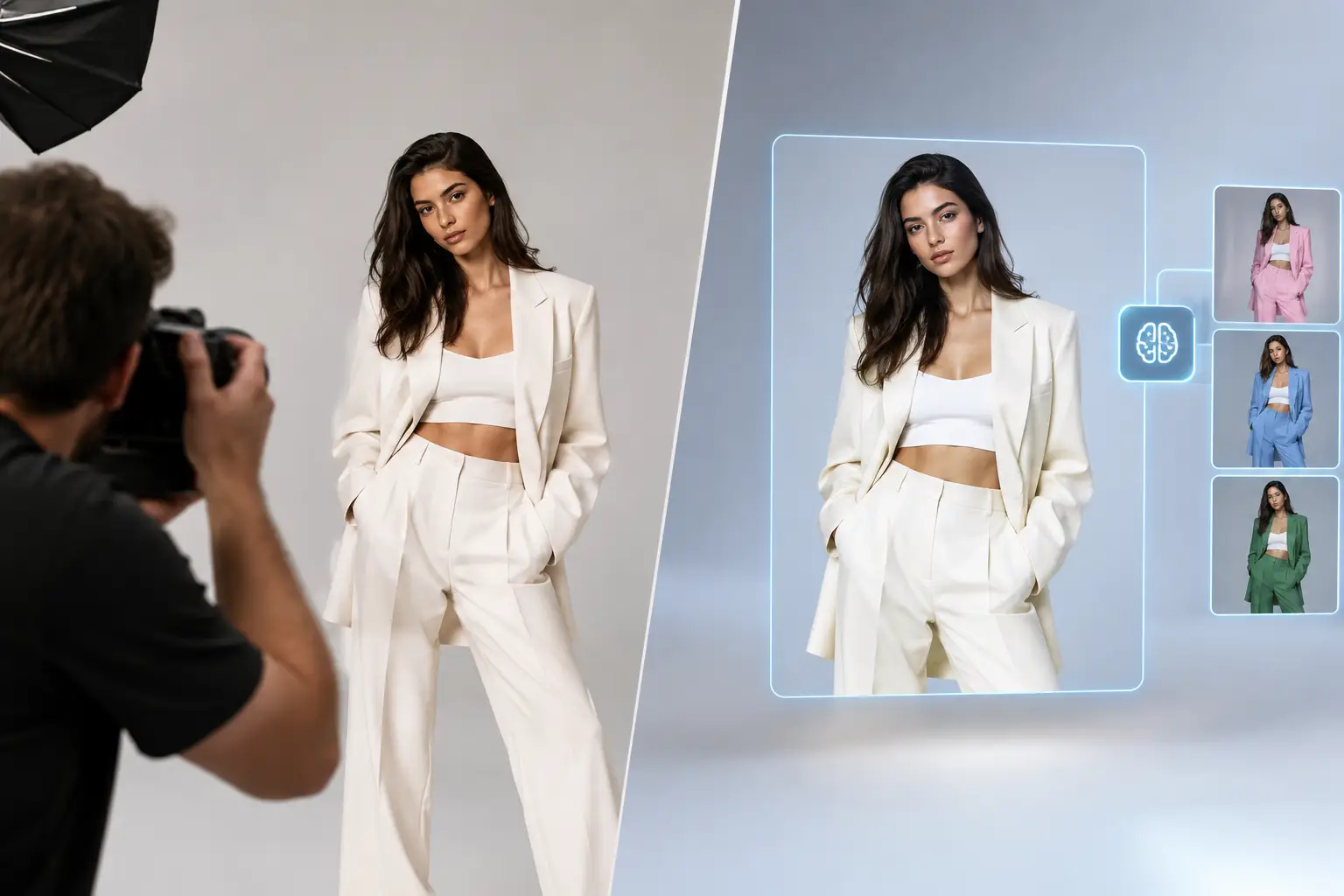
AI fashion photography vs traditional photoshoots, what's actually different
By Snaproom · September 17, 2026 · 8 min read
A restock lands on Tuesday and the product pages need images by Friday. In the old model that means booking a studio, finding a model, coordinating samples, and waiting on retouching. Whether AI fashion photography can replace that process is not a creative debate, it is a question of whether inventory can go live while demand is still there.
The two methods are not really competing on quality anymore. They compete on where the cost sits, how long it takes, and how much human checking the result needs before it can go on a product page. Those are answerable with numbers, not opinions.
Traditional photography runs from roughly $25 for a simple packshot to $500 or more per styled image, plus a $2,000 to $15,000 day rate if a model is involved, with results back in one to four weeks. AI generation runs from a few cents to a few dollars per image and returns results in minutes. The gap looks enormous until you notice most published comparisons stack a raw AI API cost against a full traditional shoot day, which inflates the savings number. The honest comparison is per finished, usable image, and even then AI wins on cost and speed for catalog volume. It does not automatically win on garment accuracy, which still needs a human check either way.
A traditional shoot starts with a plan and then requires people, a location, equipment, and post-production before a single usable image exists. An AI workflow starts with the garment. Upload a clean flat-lay, hanger, or mannequin photo, then generate model shots, studio backgrounds, and variations from that one source. The bottleneck moves from booking a crew to preparing a source image that is accurate enough to generate from.
That shift matters most for volume. A single SKU might need a white-background main image, front and back views, a detail crop, and a lifestyle shot. A traditional shoot treats each of those as a separate setup or a separate retouching request. AI can produce all of them from the same source image in one session.
The numbers below are cross-checked ranges, not a single vendor's marketing claim. Where they don't get compared like-for-like is exactly why AI vs traditional cost claims swing so wildly between articles.
| Cost driver | Traditional | AI generation |
|---|---|---|
| Simple packshot, no model | $25–$75 per image | $0.10–$6 per image |
| Styled shot with a model | $150–$500+ per image | $0.10–$6 per image |
| Full model shoot day | $2,000–$15,000 | Not applicable, no day rate |
| Studio rental (full day) | $400–$1,500+ | Not applicable |
| Turnaround per batch | 6–8 business days once booked | Minutes per image |
| Booking lead time | 4–8 weeks ahead of launch | None |
The cost gap narrows for very small orders and widens fast with volume, because a traditional shoot's fixed costs, the studio, the model day rate, the crew, get spread across however many images come out of that one booking. Ten images from a $12,000 shoot day cost more per image than 100 images from the same day. AI has no equivalent fixed cost to spread, so the per-image price stays flat whether you generate 5 images or 500.
A traditional shoot is governed by calendars, booking lead time before the shoot, then editing and retouching after it. A model getting sick or a sample shipping late adds days on top of that. None of that is unusual, it's just what physical production involves.
AI removes most of the waiting, but not the need for review. Generating an image takes minutes. Checking that the print scale, seam placement, and fabric texture match the physical garment still takes a human, and that step doesn't get faster just because generation did.
A traditional photo of a garment is, by definition, accurate, the camera recorded what was actually there. An AI-generated image is a reconstruction, and reconstructions can quietly drift from the source. The failure modes worth checking for every time:
None of that is a reason to avoid AI, it's a reason to check the output at full size against the physical garment before publishing, the same way a retoucher would check a traditional shoot before it ships. For the mechanics of that check, see what AI fashion photography actually is.
Most brands doing this well don't pick a side. A small number of hero images get shot traditionally for the campaign moment, then the same accurate garment photos feed an AI workflow for the rest of the catalog, restocks, marketplace galleries, and paid social variations. That splits the budget toward the images that need bespoke art direction and away from the images that mainly need to exist, consistently, across every SKU. For a deeper look at cost specifically for on-model images, see how small brands replace photoshoots with AI model photos, and for commercial rights before publishing either type of image, see commercial rights for AI images.
Per finished image, yes, generation typically costs a few cents to a few dollars against $25 to $500+ for a traditional shot. The comparison gets misleading when an article compares a raw AI API cost to a full traditional shoot day rather than to the per-image cost of that shoot.
A traditional shoot typically needs 4 to 8 weeks of booking lead time plus 6 to 8 business days of turnaround once it happens. AI generation returns results in minutes, though checking accuracy against the physical garment still takes time regardless of method.
Most brands that do this well keep a small number of traditional hero shoots for campaign moments and use AI for catalog volume, restocks, and marketplace galleries, where consistency and speed matter more than bespoke art direction.
It can, if a generated image changes a garment's true color, print scale, or construction details without being checked. The fix is reviewing every image at full size against the physical product before publishing, the same discipline a traditional shoot's retoucher would apply.
For campaigns that need real motion, a specific location, a recognizable person, or highly complex construction like sheer layering or structured tailoring, where a camera documenting the exact physical result matters more than generating a plausible one.
Generate model shots, studio backgrounds, and variations without booking a shoot for every restock.
Try SnaproomTurn one product image into a complete studio-grade AI model photo set.
Learn more →Place your garment on diverse AI models for realistic size and style representation.
Learn more →Generate front, back, side, and detail views from a single clothing image.
Learn more →