AI virtual try-on for clothes, what it actually is and what most guides get wrong
By Snaproom · September 17, 2026 · 7 min read
About a quarter of everything sold online in apparel comes back. Most of that is not damage or a wrong item, it's a shopper who couldn't tell whether the garment would actually fit or look right on a body before they clicked buy. "Virtual try-on" gets pitched as the fix for this, but the term covers two different technologies that solve two different problems, and most guides use it for both without saying so.
That mix-up matters because the two technologies have different inputs, different costs, and different jobs. Picking the wrong one for what you actually need wastes budget and doesn't move the number you were trying to move.
"Virtual try-on" means two different things. Brand-side model generation takes a flat lay or mannequin photo and puts the garment on an AI-generated model, producing the catalog and campaign images every visitor sees, it replaces a photoshoot. Customer-facing try-on takes the shopper's own uploaded photo and maps the garment onto their body, an interactive step they choose to take, it replaces a fitting room. Most sellers searching for "AI virtual try-on" actually want the first one, catalog imagery, not a body-mapping feature. Confusing the two means evaluating the wrong tools for your actual problem.
Brand-side model generation starts with your product photo. Upload a flat lay, hanger shot, or mannequin image, choose a model and setting, and the system generates on-model imagery for your listings, ads, and campaigns. The output is produced once and works passively for every visitor who lands on that product page.
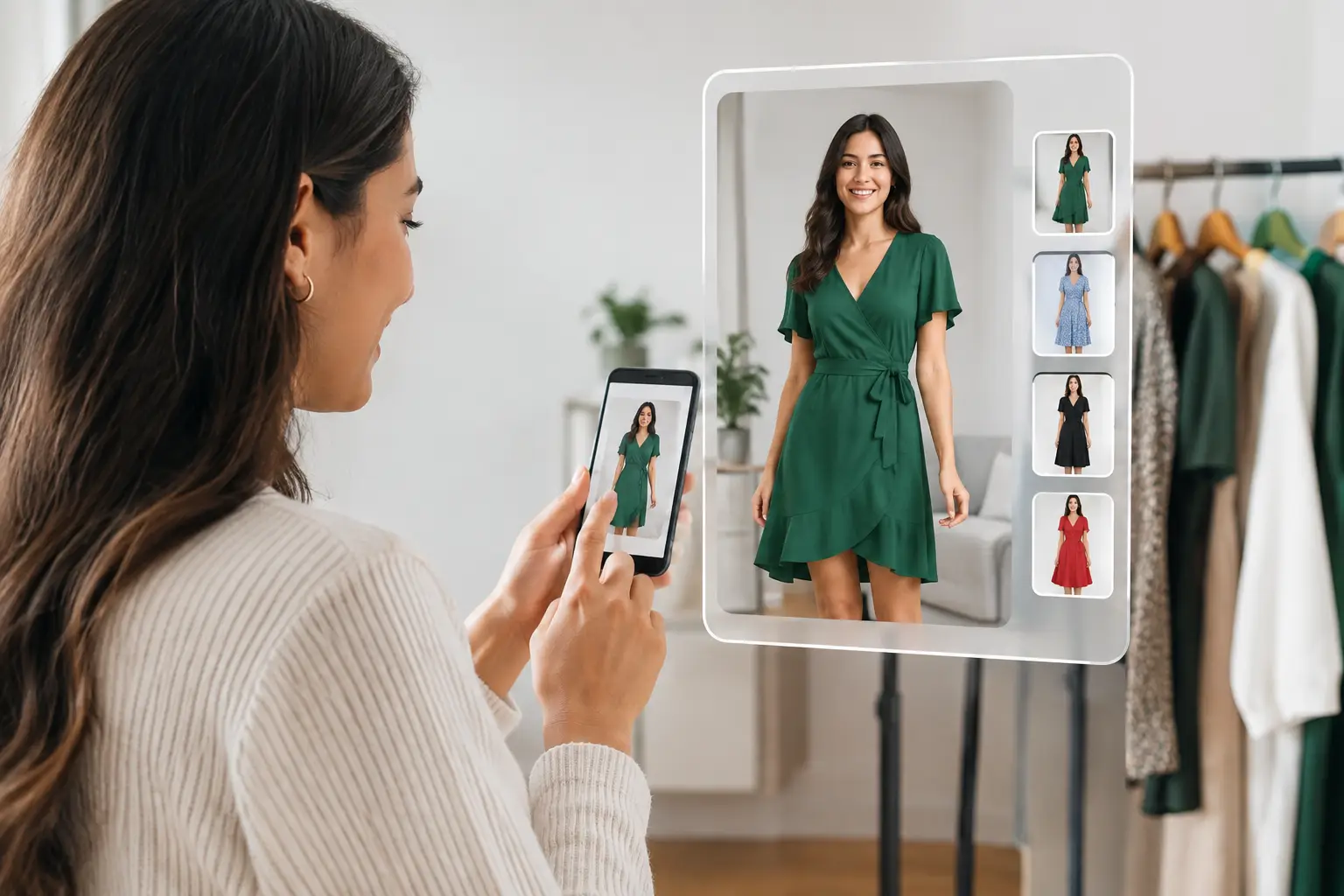
Customer-facing try-on starts with the shopper. They upload their own photo, or use a saved body profile, and the tool maps a specific garment onto their proportions in real time, usually as a widget on the product page. It's an engagement layer the shopper has to actively use, its value depends on how many people take that extra step and how convincing the result looks.
| Brand-side model generation | Customer-facing try-on | |
|---|---|---|
| Input | Your flat lay or mannequin photo | The shopper's own photo or body profile |
| Output | Catalog and campaign images | An interactive on-page preview |
| Who sees it | Every visitor, passively | Only shoppers who choose to try it |
| What it replaces | A photoshoot | A fitting room |
| Primary goal | Listing and ad content at scale | Reducing fit-related returns |
A seller with 200 SKUs and no photography budget needs brand-side generation, images for every listing. A retailer trying to bring down a high fit-related return rate needs customer-facing try-on, a tool that reduces size uncertainty at the point of purchase. They're solving different problems, and a tool built for one doesn't meaningfully help with the other, a catalog image generator won't cut your return rate, and a fitting-room widget won't fill your empty product listings.
The case for customer-facing try-on rests on real numbers. Online apparel returns run roughly 23% to 25% in the US, close to three times the in-store rate, and fit or sizing issues account for somewhere between half and two-thirds of that. That's the gap customer-facing try-on and sizing tools are built to close.
How much a specific tool actually closes that gap varies. One published case study reported a 47% drop in size-related returns for a single swimwear brand over six months, but that's one vendor-run study on one brand, not an industry-wide guarantee. Treat any specific return-reduction percentage you see quoted as a best case from a specific brand's specific catalog, not a number that transfers automatically to yours.
This is the category most apparel sellers land in when they search for virtual try-on, and it's a genuinely useful production tool: turn one clean garment photo into the model shots, alternate poses, and channel-specific crops a listing needs, without booking a shoot for every restock. For the full step-by-step workflow, source-image standards, and per-channel formatting, see how small brands replace photoshoots with AI model photos.
Both categories carry the same core risk, a generated image that quietly stops matching the physical garment. Before publishing anything generated:
For the full accuracy checklist and the specific failure modes to look for, see what AI fashion photography actually is.
Not exactly. Both can use similar underlying AI, but brand-side model generation produces catalog images from your product photo, while customer-facing virtual try-on maps a garment onto the shopper's own photo as an interactive feature. Most sellers looking for catalog content actually want the first one.
Customer-facing try-on and sizing tools are built to address fit uncertainty, which drives roughly half to two-thirds of apparel returns. Reported results vary by brand and tool, treat any specific reduction percentage as one case study's result, not a guaranteed outcome for your catalog.
Online apparel returns run roughly 23% to 25% in the US, about three times the in-store rate. Fit and sizing issues account for somewhere between half and two-thirds of those returns, depending on the source and category.
Brand-side model generation, turning your garment photo into on-model catalog and campaign imagery. It does not map garments onto a shopper's own uploaded photo.
Yes, generated on-model images are used on listings the same as traditional photography, provided they accurately represent the garment a buyer will receive. Check color, print scale, and construction details against the source photo before publishing.
Generate on-model imagery, alternate poses, and channel-ready crops without booking a shoot.
Try SnaproomTurn one product image into a complete studio-grade AI model photo set.
Learn more →Place your garment on diverse AI models for realistic size and style representation.
Learn more →Generate front, back, side, and detail views from a single clothing image.
Learn more →